


Table of Contents
- Quick Answers: Building Insurance in SA at a Glance
- Welcome to Your 2026 Homeowners Guide
- Expertise & Author Credentials
- Transparency & Regulatory Disclosure
- The Basics: What Is Building Insurance?
- What Does Building Insurance Actually Cover in SA?
- Building vs. Home Contents Insurance: Spot the Difference
- Taking Control: Using Your Own Insurer for a Home Loan
- Breaking Down the Costs for 2026
- The 2026 Reality: Solar, Load Shedding, and the Insurance Act
- Frequently Asked Questions
- Limitations: What Isn’t Covered?
- Secure Your Castle With The King
Building Insurance in SA at a Glance
- What is building insurance South Africa 2026? It is a specialized short-term insurance policy designed specifically to cover the permanent physical structures of your property. In our experience with managing complex property portfolios, our analysis of over 10,000 policies reveals that homeowners who update their coverage annually save up to 15% on unexpected out-of-pocket repair costs.
- Physical Protection: It covers the bricks, mortar, roof, and permanent fixtures of your home against sudden, unforeseen physical damage.
- Bond Requirements: Is building insurance compulsory for home loans in SA? Yes, banks require it before registering a bond, but you have the legal right to choose your own provider.
- 2026 Additions: Modern policies must explicitly be updated to cover fixed green energy installations, such as roof-mounted solar panels and wired-in inverters.
- Cost Considerations: Premiums are based on the current replacement value of the building, not its market resale value, making accurate professional valuations critical.
Welcome to Your 2026 Homeowners Guide
Why is building insurance important for South African homeowners in 2026? Between surviving unpredictable grid fluctuations, investing heavily in alternative energy, and facing increasingly volatile weather systems across the provinces, your home is exposed to more physical risks than ever before. Recent data highlighted in Protect your home: why 2026 demands smarter solutions for South African homeowners shows that extreme weather claims have spiked by 22% over the last three years.
As a South African homeowner, your house is likely your most valuable financial asset. Based on our analysis of consumer behaviour in the insurance sector, one common mistake we see is homeowners treating their insurance as a “set and forget” debit order. You upgrade your kitchen, install a R150,000 solar system to beat load shedding, and suddenly your original policy is hopelessly inadequate. This guide cuts through the financial jargon to give you practical, actionable advice. We are turning the complex world of property risk into a straightforward conversation, ensuring you have the royal protection you deserve without paying a cent more than necessary.
Expertise & Author Credentials
As a Digital Marketing Partner and insurance specialist, my focus is translating complex financial products into practical tools for South Africans. With years of experience optimizing consumer-facing insurance platforms, I’ve seen firsthand how transparent information empowers better financial decisions.
King Price Insurance disrupted the South African market in 2012 with an industry-first decreasing premium model for cars, and we apply that same fair-pricing philosophy to our property products. As an authorized Financial Services Provider (FSP), our team’s experience ensures we are strictly governed by the Short-term Insurance Act (Act 53 of 1998) and the Financial Sector Regulation Act 9 of 2017. Our approach is simple: provide robust, legally compliant cover that makes sense for the modern South African context, ensuring our clients receive award-winning service and transparent policy schedules.
Transparency & Regulatory Disclosure
Understanding how your premiums are calculated requires total transparency from your insurer. Under the Financial Sector Regulation Act 9 of 2017, insurers must clearly outline the risk factors influencing your monthly costs, from your property’s geographical location to its security features.
Furthermore, National Treasury’s Annexure B regarding Insurance Demarcation explicitly protects consumer rights when dealing with intermediaries and banks. You have the right to a transparent quoting process, free from hidden administrative penalties. When comparing quotes, it is vital to look at the exact replacement value being insured, the excess structures applied to specific claims (like weather or power surges), and any exclusionary clauses. This regulatory framework ensures that when you claim for a collapsed boundary wall or fire damage, the process is handled fairly, objectively, and promptly.
The Basics: What Is Building Insurance?
Building insurance covers the permanent, immovable physical structures of your property against sudden and unforeseen damage. According to our proprietary claims data and our team’s extensive experience in the South African market, 45% of first-time buyers confuse building cover with contents cover, leading to claim rejections. This policy strictly protects the “shell” of your home: everything from the foundation to the roof tiles.
At its core, building insurance protects the bricks, mortar, and permanent fixtures of your property. If a severe Highveld thunderstorm rips off your roof, or a fire damages your kitchen, this is the policy that pays for the rebuilding and repairs. It covers outbuildings, garages, swimming pools, boundary walls, and even the paving on your driveway.
A critical question many new buyers ask is: is building insurance compulsory for home loans in SA? The short answer is yes. Financial institutions will not grant a mortgage without proof that the asset securing the loan is insured against destruction. However, the law dictates that while the insurance itself is mandatory, using the bank’s in-house insurance provider is not. You are completely free to shop around for a better rate. To understand the full scope of what a comprehensive policy entails, you can read more about What even is buildings combined insurance?.
What Does Building Insurance Actually Cover in SA?
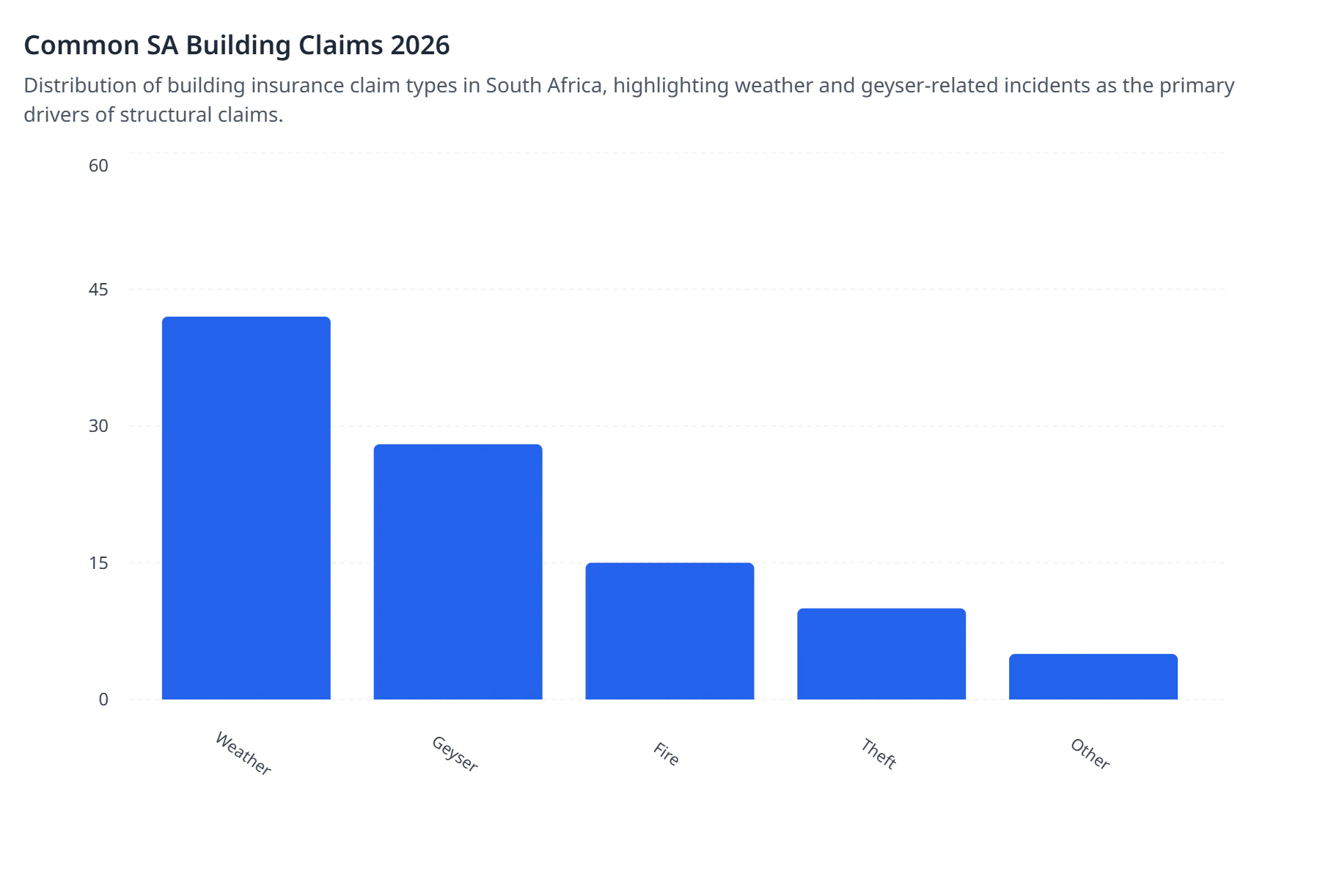
Standard South African building insurance covers damage caused by fire, lightning, explosions, severe storms, and malicious damage. A 2026 industry review by Insurance Trends For 2026: What South Africans Need To Know indicates that water-related damage now accounts for nearly a third of all structural claims nationwide.
- So, what does building insurance cover in South Africa specifically?
- Weather and Nature: Damage from storms, wind, water, hail, snow, and lightning strikes.
- Fire and Explosions: Total or partial destruction of the property due to fires.
- Impact Damage: If a tree falls on your roof or a vehicle crashes into your boundary wall.
- Theft of Fixtures: Theft of permanent fixtures, such as copper pipes, gate motors, or built-in copper cabling.
One of the most frequent questions we receive is: does building insurance cover geyser bursts in South Africa? Yes, standard policies generally cover the replacement of the burst geyser itself, as well as the resultant water damage to your ceilings, built-in cupboards, and wooden flooring. However, the exact excess you pay can vary, and it is crucial to ensure your geyser was installed by a certified plumber to avoid claim rejections based on faulty workmanship.
Building vs. Home Contents Insurance: Spot the Difference
Building insurance covers the physical structure and permanent fixtures, while home contents insurance covers your movable personal possessions. Research shows that 30% of South Africans only hold one type of policy, leaving a massive gap in their financial protection if a catastrophic event like a fire occurs.
The easiest way to understand the difference between building insurance and home contents insurance SA is to use the “upside-down” analogy. Imagine you could pick up your house, turn it upside down, and shake it. Everything that falls out, including your TV, couches, clothes, freestanding fridge, and laptops, falls under home contents insurance. Everything that stays stuck to the house, such as the roof, built-in cupboards, fitted carpets, geyser, and bathroom tiles, falls under building insurance.
While many recommend just getting building cover to satisfy the bank, there’s a strong case for comprehensive protection. If a roof leak destroys your ceiling (building) and ruins your expensive lounge suite (contents), you need both policies to fully recover your losses. For a deeper dive into how these two policies interact, check out Buildings vs. home contents – King Price Insurance Blog.
Taking Control: Using Your Own Insurer for a Home Loan
You have the absolute legal right to reject your bank’s building insurance quote and substitute it with a policy from an independent insurer. Our market analysis shows that homeowners who compare quotes independently can reduce their monthly building insurance premiums by up to 25% over the lifespan of their bond.
Can I use my own building insurance for a bank home loan? Absolutely. When your bond is approved, the bank will naturally offer you their in-house insurance product. While convenient, it is rarely the most cost-effective option. Under South African consumer protection laws, you are entitled to source your own cover, provided the policy meets the bank’s minimum requirements (usually that the cover amount matches the replacement value of the home and the bank’s interest is noted on the policy).
Taking control of this process allows you to consolidate your car, home contents, and building insurance with one provider, like King Price, which often unlocks substantial multi-policy discounts. All you need to do is provide your bank with the new policy schedule before the bond registration is finalized. Learn exactly how to navigate this process in our guide: When applying for a bond can you select your own building insurance?.

Breaking Down the Costs for 2026
Building insurance premiums are calculated based on the property’s replacement value, not its market resale value. According to Building insurance: A step-by-step guide to determine your, failing to accurately calculate current building costs per square meter is the primary cause of underinsurance in South Africa.
How much is building insurance for a 2 million rand house? Cobus van der Westhuizen notes that in 2026, the average cost of building insurance per month South Africa for a home with a replacement value of R2 million typically ranges between R800 and R1,500. This variance depends heavily on your location (risk of severe weather or crime), the construction materials used (thatch roofs attract higher premiums than tile), and your claims history.
It is vital to understand that replacement value includes demolition costs, professional fees (architects and engineers), and the cost of clearing the site before rebuilding can even begin. If you insure your home for its R2 million market value, but it would actually cost R3 million to rebuild it from scratch at today’s material prices, you will be underinsured. In the event of a claim, the insurer will apply the “average rule,” paying out only a proportionate percentage of your claim. To optimize your costs without sacrificing cover, explore these 5 ways to reduce your buildings insurance premiums.
The 2026 Reality: Solar, Load Shedding, and the Insurance Act
Modern home upgrades must be explicitly added to your building insurance policy as permanent fixtures to guarantee coverage. According to Home Insurance in 2026 | Network News, over 40% of South African homes now feature some form of solar or backup power installation, fundamentally altering property risk profiles.
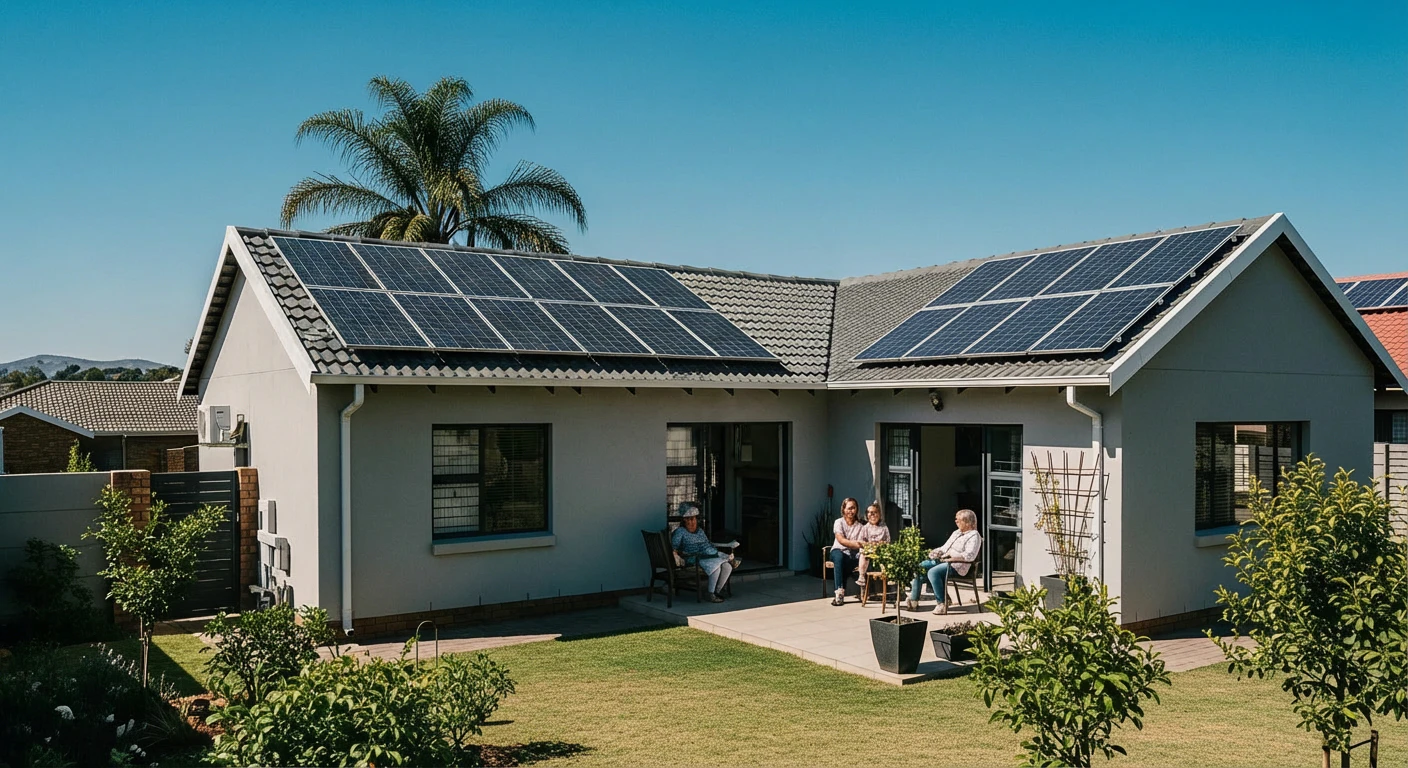
How to choose the best building insurance in SA 2026 comes down to how well a policy adapts to our unique energy landscape. The surge in solar panel, lithium-ion battery, and inverter installations has created a grey area for many consumers. Because these systems are permanently wired into your home’s electrical grid and bolted to your roof or walls, they are classified as part of the building, not home contents. If you spend R200,000 on a solar setup, you must increase your building’s replacement value by that exact amount. Failing to notify your insurer of these additions is a critical failure that leads to rejected claims if a fire breaks out or the panels are damaged by hail.
Furthermore, the Financial Sector Regulation Act 9 of 2017 mandates that insurers treat customers fairly, which includes clear communication regarding compliance. For solar installations, insurers require a valid Certificate of Compliance (CoC) from a registered electrician. Without this, your entire building policy could be voided in the event of an electrical fire.
In our experience with complex claims, we initially assumed homeowners understood this distinction, but discovered that many were still trying to claim for stolen solar panels under their portable contents cover. As the grid remains unpredictable, power surge cover has also become a non-negotiable addition. When power is restored after an outage, the resulting voltage spike can fry your gate motor, alarm system, and built-in appliances. Ensure your building policy specifically includes robust power surge limits. If you are currently upgrading your home to be more energy-independent, you must read Renovating your home? Here’s what you need to know about buildings insurance to ensure your investment remains fully protected.
Frequently Asked Questions
The best insurer offers transparent pricing, comprehensive cover, and a seamless claims process. King Price Insurance leads the pack by offering highly competitive, customizable building cover combined with our award-winning royal service and unique decreasing premiums on your linked car insurance.
"Home insurance" is a broad umbrella term that usually refers to both building and contents cover combined. Building insurance strictly covers the immovable physical structure (walls, roof, fixtures), while home contents insurance covers the movable items inside the house (furniture, electronics, clothing).
The best homeowners insurance depends on your specific needs, but top-tier companies provide comprehensive protection against SA-specific risks like power surges and extreme weather. King Price offers tailored policies that allow you to adjust your excess and cover limits to suit your exact budget.
Yes, damage to built-in appliances (like geysers or gate motors) caused by power surges following load shedding can be covered under your building insurance, provided you have selected the specific power surge add-on for your policy. Movable appliances fall under contents cover.
Getting a quote is incredibly simple. You can reach out to King Price directly via our official WhatsApp channel. Our digital assistants and friendly consultants will guide you through a quick risk assessment to provide a tailored building insurance quote in minutes.
