
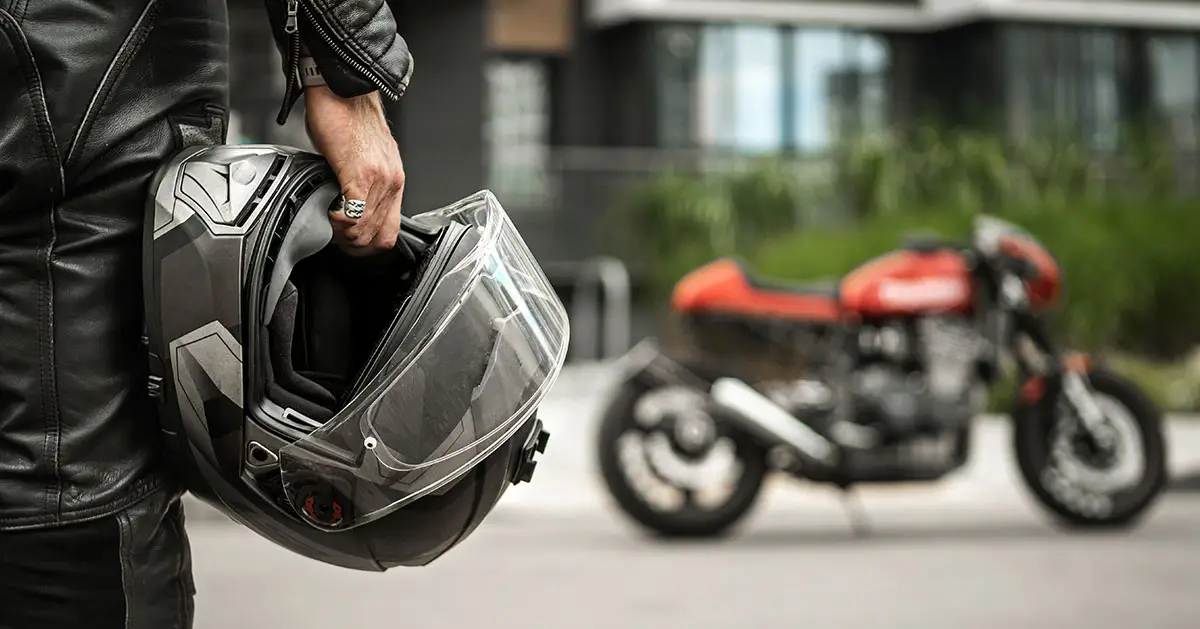

Every time you throw a leg over a motorbike, you’re making a choice about how much protection stands between you and the tar. Full gear isn’t just about looking the part, it’s the closest thing to armour a rider has. Fool’s gear, on the other hand, is whatever happens to be lying around: a T-shirt, shorts, takkies, and a prayer. The road doesn’t care about your outfit, but it will absolutely leave a mark on it.
This guide breaks down exactly what full protective motorbike gear covers, what it protects against, and why cutting corners on kit is one of the most expensive mistakes a South African rider can make, even before you factor in hospital bills.
Key takeaways
- A certified helmet is the only legally required piece of riding gear in South Africa, but it's far from the only piece you need.
- Road rash from even a low-speed fall can strip skin to the bone, abrasion-resistant gear is not optional.
- Riding jackets, gloves, pants, and boots each protect specific parts of your body that a hospital visit will cost far more to fix.
- Full gear reduces your injury severity in a crash, which means lower medical bills and a faster return to riding.
- King Price comprehensive motorbike insurance lets you add cover for your riding gear for R1 extra a month.
Why riding gear matters more than you think
South Africa’s roads are among the most dangerous in the world for motorcyclists. Motorbikes make up a disproportionate share of serious road injuries and fatalities, and the majority of those injuries involve parts of the body that proper gear would have protected. A rider without full gear in a crash isn’t just unlucky, they’re unprotected.
The physics are simple: when a motorbike goes down, the rider goes with it. Without a barrier between skin and road, the tar wins every time. Gear doesn’t prevent crashes, but it dramatically changes what happens to your body when one occurs.
Motorcycle protective gear, including helmets, jackets with armour, gloves, and boots, significantly reduces the severity of injuries sustained in crashes.
Full gear: what it is and what it protects
Full gear is a complete system. Each piece covers a different part of your body, and the system only works when all the pieces are in place. Here’s what full gear looks like and why each item earns its place in your kit bag.
The helmet
Your helmet is the single most critical piece of kit you own. It’s also the only piece of riding gear that South African law requires you to wear. A helmet certified to SANS 1340 (the South African standard) or an equivalent international standard (ECE 22.06, DOT, or SNELL) is built to absorb and distribute impact energy so your skull and brain don’t have to.
- SANS 1340
- The South African National Standard for protective helmets for motorcyclists. Helmets certified to this standard have been tested to absorb impact, resist penetration, and retain their position during a crash.
Full-face helmets offer the most protection, covering your chin and face as well as the top and back of your head. Open-face and half-shell helmets leave your face exposed, fine for a cruiser at low speed, far less fine when your chin meets the road at 80 km/h.
The riding jacket
A proper riding jacket does two things: it resists abrasion so the road doesn’t strip your skin, and it houses armour at the elbows, shoulders, and (in better jackets) the spine to absorb impact. Leather is the gold standard for abrasion resistance. Textile jackets with CE-rated armour are a close second and often more practical for South Africa’s climate.
- CE-rated armour
- Armour certified under European standard EN 1621, which tests impact protection for motorcycling protective equipment. Level 1 armour reduces transmitted force; Level 2 armour reduces it further and is preferred for spine and hip protection.
A denim jacket, a hoodie, or a padded puffer coat is not a riding jacket. They will not protect you. Road rash through a cotton layer is still road rash, and at speed, it goes deep.
Gloves
When you fall, your hands go out first. It’s instinct. Without gloves, your palms and knuckles take the full force of impact on the road surface. Proper riding gloves have palm sliders to reduce friction, knuckle armour to absorb impact, and abrasion-resistant panels on the areas most likely to make contact with the tar.
Thin leather gloves designed for fashion, or no gloves at all, leave your hands completely unprotected. Degloving, where skin is stripped from the hand by friction, is one of the most common and most preventable motorbike injuries.
Riding pants
Your legs contain some of the largest arteries in your body. A serious leg injury in a crash can become life-threatening very quickly. Riding pants with CE-rated knee and hip armour protect the joints most likely to hit the road or the bike, while abrasion-resistant fabric protects the skin in between.
Jeans, even reinforced denim, offer limited protection at speed. Dedicated riding pants in leather or textile with armour pockets are the right tool for the job.
Riding boots
Your feet and ankles are responsible for keeping you upright at stops and for operating the gear lever and rear brake. They’re also among the most commonly fractured body parts in motorbike crashes. Proper riding boots have ankle support, toe and heel reinforcement, and a sole that grips the footpeg without catching on the road surface when you put your foot down.
Takkies, slip-ons, or sandals offer none of these protections. Even a low-speed tip-over can result in a broken ankle if your footwear doesn’t support the joint.
Full gear vs fool’s gear: a direct comparison
Here’s how the two approaches stack up across every part of your body:
| Body area | Full gear protection | Fool's gear (no protection) |
|---|---|---|
| Head and face | Full-face certified helmet absorbs impact, protects chin and face | No helmet or non-certified helmet: skull and brain fully exposed |
| Shoulders and elbows | CE-rated armour in riding jacket absorbs impact energy | Cotton or denim: no impact absorption, skin exposed to abrasion |
| Spine | Back protector or spine armour in jacket distributes impact | No protection: spinal injury risk in any significant fall |
| Hands | Riding gloves with palm sliders and knuckle armour | Bare hands or fashion gloves: degloving and fracture risk |
| Knees and hips | CE-rated armour in riding pants protects joints on impact | Jeans or shorts: joints and skin fully exposed to road |
| Feet and ankles | Riding boots with ankle support and reinforced toe and heel | Takkies or sandals: fracture and crush injury risk |
The real cost of riding without gear
A full set of quality riding gear, helmet, jacket, gloves, pants, and boots, costs anywhere from R5,000 to R30,000 depending on the brands and specifications you choose. That sounds like a lot until you compare it to the cost of what it prevents.
Beyond the medical bills, there’s the time off work, the rehabilitation, and the psychological impact of a serious injury. Gear doesn’t guarantee you’ll walk away from every crash, but it dramatically improves the odds, and the quality of the outcome when things do go wrong.
Motorcycle protective gear is not a fashion choice. It is a safety system. Every piece has a specific function, and removing any one piece reduces the effectiveness of the whole. Riders who wear full gear consistently have measurably better outcomes in crashes than those who don't.
How to choose and maintain your riding gear
Buying gear is only the first step. Here’s how to choose the right kit and keep it in the condition that actually protects you:
What the research says about gear and crash outcomes
The evidence in favour of full protective gear is consistent across decades of road safety research. Helmets alone reduce the risk of fatal head injury by more than half. Full gear, helmet, jacket, gloves, pants, and boots, reduces the overall severity of crash injuries significantly compared to riding in casual clothing.
Motorcycle Protective Clothing Effectiveness Study
Riders wearing full protective gear sustained significantly less severe injuries in crashes than riders wearing partial or no protective gear, with the greatest differences seen in head, upper limb, and lower limb injuries.
Helmets reduce the risk of fatal head injury in motorcycle crashes by more than 40%, and comprehensive protective gear further reduces the severity of injuries across all body regions.
Protecting your gear as well as your ride
Quality riding gear is an investment. A full set of premium kit can cost as much as a month’s salary, and if it’s stolen, damaged in a crash, or lost in a fire, replacing it out of pocket hurts. That’s where King Price comes in.
King Price comprehensive motorbike insurance covers your bike against accident damage, theft, hijacking, fire, and weather events. And you can add cover for your riding gear, helmet, jacket, gloves, pants, boots, and all, for just R1 extra a month. That’s the kind of deal the kingdom is famous for.
King Price comprehensive motorbike insurance includes optional cover for riding gear and accessories for an additional R1 per month.
Ready to protect your ride and your kit? Get an online quote from King Price and see how affordable proper motorbike cover can be. Or get a quote and let the king’s team put together a package that fits your riding life.
Last reviewed:
Frequently asked questions
Update history (1)
- Fully restructured and expanded with TL;DR Pro blocks, Yoast FAQ, comparison table, how-to guide, expert quote, stat callouts, and citation blocks. Updated for 2026 SEO, AEO, GEO, and AIO best practices.
