

High walls and sturdy locks are a good start, but they’re not enough on their own. A proper home security system works in layers, each one making it harder for an intruder to get in, and faster for armed response to get to you if they do. Understanding what those layers are, and how they work together, helps you have a much more useful conversation with any security company before you sign a contract.
Key takeaways
- A layered security system is far more effective than any single feature alone.
- Your alarm and panic buttons must be linked to an armed response unit to be useful in an emergency.
- Outdoor perimeter beams stop intruders before they reach your home, not just after they're already inside.
- An automated gate removes the dangerous moment of stepping out of your car to open it manually.
- A good home security system can work in your favour when it comes to your home contents insurance premium.
Why home security needs more than locks and walls
Burglars don’t choose homes at random. They look for easy targets, properties where entry is quick, undetected, and uncontested. A layered security system changes that calculation at every step. The goal isn’t just to respond to a break-in; it’s to make your home look and feel like too much effort to bother with.
Before you call security companies for quotes, it helps to think like a thief. Walk around your property and ask: where are the blind spots? Which walls are low enough to climb? Where does your lighting fail at night? What happens if someone cuts your alarm cable? The answers tell you which features to prioritise.
- Armed response
- A private security service where a team of officers is dispatched to your property when your alarm or panic button is triggered. Response time and patrol frequency vary by provider and contract.
The essential features of a home security system
Here’s a breakdown of the core components, what each one does, and what to look for when choosing a provider.
Automated lights
Automated timers for lights are one of the simplest and most effective deterrents available. The idea is straightforward: set your indoor lights to switch on and off at times that mimic your normal movements, so the home looks occupied even when it isn’t. Outdoor lights typically work on a timer or a motion sensor, but automating your bedroom and living room lights adds another layer of convincing activity.
- Use motion-activated floodlights along driveways and side passages.
- Set indoor timers to vary, identical on/off times every night can look mechanical.
- Smart plugs make it easy to automate any standard lamp without rewiring.
Alarm system
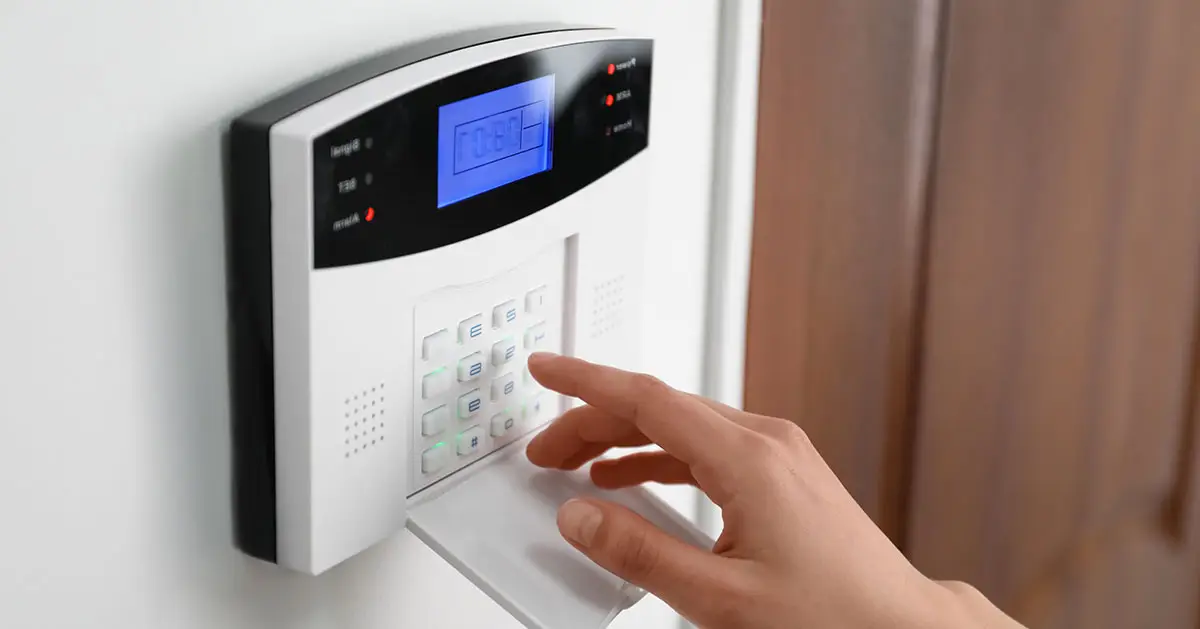
An alarm system is the backbone of most home security setups. Modern systems have moved well beyond the old keypad-and-siren combination. Wireless technology means fewer vulnerabilities from cut cables, and many systems now allow you to arm or disarm remotely via a smartphone app or a dedicated remote. Some systems also send an instant notification to your phone and your armed response company the moment the alarm triggers.
- Wireless alarm system
- An alarm system that uses radio frequency signals rather than physical wiring to connect sensors, keypads, and the control panel. Wireless systems are harder to disable by cutting cables.
When comparing alarm systems, ask providers specifically about battery backup (for load shedding), cellular communication (so a cut phone line doesn’t silence your alarm), and whether the system integrates with their armed response monitoring centre.
Panic buttons
A panic button is only as useful as what it’s connected to. Make sure yours links directly to an armed response unit with a guaranteed response time, and get that response time in writing. Panic buttons should be installed at strategic points throughout the house: near the front door, in the main bedroom, in the kitchen, and on any remote controls for your alarm system.
- Ask your security company for their average response time in your area before signing up.
- Test your panic button regularly, at least once every three months.
- Make sure every adult in the household knows where the buttons are and how to use them.
Outdoor perimeter beams
Burglar bars on windows stop intruders from getting inside. Perimeter beams stop them from even reaching your walls. Beam systems installed in your garden and along the perimeter of your property trigger the alarm the moment they’re broken, giving you and your armed response company a head start before anyone is close to your home.
If you have pets, this matters: most reputable security companies offer pet-friendly garden beams that only trigger above a certain height and weight threshold. Confirm the specifications before installation to avoid false alarms that desensitise your response team.
Pet-friendly perimeter beams are calibrated to trigger only above a set height and weight threshold, reducing false alarms caused by animals moving through the garden.
Electric fencing and automated gates
Getting out of your car to open a manual gate is one of the most vulnerable moments in any homeowner’s day. An automated gate eliminates that exposure entirely. Pair it with electric fencing along your perimeter walls and gate, and you’ve added a physical deterrent that most opportunistic intruders won’t risk.
- Electric fencing
- An electrified wire or mesh barrier installed along the top of perimeter walls or fences. It delivers a non-lethal shock to deter intruders and can be connected to your alarm system to trigger when the fence is touched or cut.
- Ensure your electric fence is connected to your alarm system so any tampering triggers an alert.
- Check with your municipality, some areas have bylaws governing the height and voltage of electric fencing.
- Automated gates should have a manual override in case of a power failure.
Surveillance cameras
Surveillance cameras serve two purposes: deterrence and evidence. Visible cameras above your front gate and at key points around your perimeter tell would-be intruders they’re being watched. Recorded footage gives police and your insurer something concrete to work with if a break-in does occur.
Place your camera monitor in a room you use frequently, and put a panic button next to it. If you spot suspicious activity on the feed, you can alert your armed response company immediately without having to leave the room to find a button.
Visible surveillance cameras act as a deterrent by signalling to potential intruders that their movements are being recorded and monitored.
How to choose the right security features for your home
Not every home needs every feature. The right combination depends on your property layout, your neighbourhood’s crime profile, your budget, and whether you have pets or outbuildings to consider. Here’s a practical way to work through it.
Comparing security system options
Security systems vary widely in cost, complexity, and effectiveness. Here’s a simplified comparison of the most common setups South African homeowners consider.
| Security feature | What it does | Best suited for |
|---|---|---|
| Automated lights | Mimics occupancy, deters opportunistic intruders | All homes, especially those left empty during the day |
| Alarm system with armed response | Alerts response unit when triggered | All homes, this is the baseline minimum |
| Outdoor perimeter beams | Detects intrusion before it reaches the home | Homes with gardens or open perimeter areas |
| Electric fencing | Physical deterrent along walls and gates | Higher-risk areas or homes with low perimeter walls |
| Automated gate | Eliminates vulnerability of manual gate operation | All homes with a driveway gate |
| Surveillance cameras | Deters intruders and provides evidence | All homes, especially those with a front gate or blind spots |
What the data says about home security and crime
SAPS Residential Burglary Crime Statistics 2024/2025
Residential burglary remains one of the most reported contact crimes in South Africa, with the highest incidence in Gauteng, the Western Cape, and KwaZulu-Natal. Properties with visible, layered security measures are statistically less likely to be targeted than those without.
The most effective home security isn't any single product, it's the combination of deterrence, detection, and rapid response working together. When intruders see multiple layers, they move on to easier targets.
How your home security system links to your insurance
A comprehensive home security system doesn’t just protect your family, it can also affect your home contents insurance. Insurers assess risk when calculating your premium, and a well-secured home is a lower-risk home. Some insurers require certain security features as a condition of cover; others reward you for having them.
Home insurers in South Africa may require certain minimum security features, such as an alarm linked to armed response, as a condition of providing home contents cover.
When you take out a King Price home contents insurance policy, make sure your security setup meets the requirements stated in your policy wording. If you upgrade your security after taking out cover, let King Price know, it could work in your favour at renewal.
And remember: even the best security system can’t prevent every loss. Floods, fires, and accidental damage happen regardless of how many cameras you have. That’s why home contents insurance and home security work best as a team, not as alternatives to each other.
Last reviewed:
Frequently asked questions
Key takeaway: a home security system that works is one that layers deterrence, detection, and rapid response, and backs it all up with a solid home contents insurance policy. Don’t wait until something goes wrong to put the pieces in place.
Ready to make sure your belongings are covered? Get an obligation-free home contents insurance quote from King Price and let the king’s team take care of the rest.
Update history (1)
- Fully restructured and rewritten for SEO, AEO, GEO, and AIO. Added TL;DR answer box, key takeaways, glossary terms, how-to steps, comparison table, stat callout, expert quote, research data, citation capsules, reviewed-by block, and Yoast FAQ with 7 questions. Removed all third-party outbound links unrelated to King Price. Updated internal links to current King Price home contents insurance product page.
