
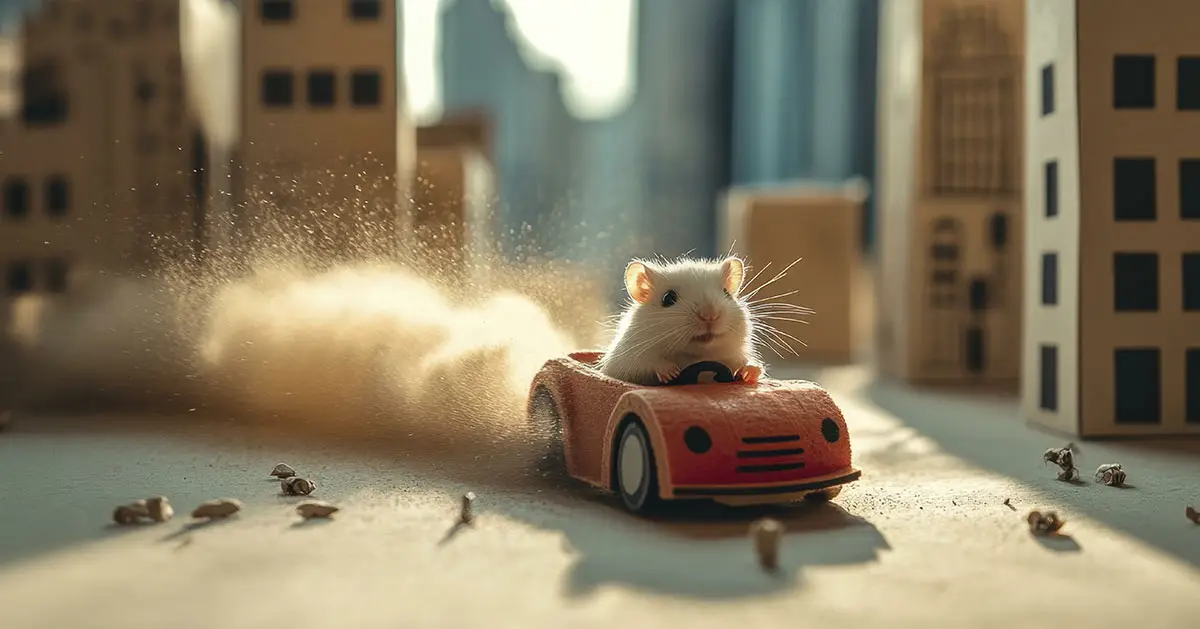
Yep, you read that right. Scientists actually trained rats to drive tiny cars! No, this isn’t the plot of a Pixar movie or the premise of a quirky new animated series. This is real science, and it might just change how you think about animal intelligence, stress, and even how you view mental wellness.
Let’s get into it.
Tiny cars, big brains
In 2019, a group of researchers at the University of Richmond in Virginia made headlines for pulling off 1 of the most delightfully strange experiments ever: They built little electric cars, popped some lab rats behind the wheel, and taught them how to drive! The rats didn’t just drive aimlessly either. They learned to steer towards a reward (a delicious Fruit Loop, obvs), proving that rodents are far more capable (and motivated by snacks) than we give them credit for.
The ‘why’ behind it all
This may seem like science gone off the rails, but there was a method to the madness. The researchers were trying to figure out if complex learning tasks (like driving) could reduce stress in animals. Turns out, it totes can!
The study found that rats who grew up in ‘enriched’ environments(think toys, tunnels, and opportunities to explore) learned to drive better and faster than those who were just chilling in standard lab cages. More impressive? They had lower stress hormone levels. Yep, driving relaxed them!
What this tells us about intelligence (and ourselves)
It’s easy to look at this story and think it’s just an internet novelty. But the implications are fascinating. First, it shows that rats are capable of complex motor skills, memory, and problem-solving. That might not make them eligible for a driver’s licence anytime soon, but it does challenge assumptions about how animal brains work.
More importantly, this research proves that learning new things and engaging our brains can be good for our mental health. So whether you’re a human with bills or a rat in a go-kart, mental stimulation = less stress. It turns out play isn’t just for fun. It’s brain fuel.
The bottom line
At its core, this experiment reminds us that joy, play, and learning aren’t extras… They’re essential. For rats, and for us.
So challenge your brain. Try new things. Say yes to new adventures (even if that adventure is finally figuring out how TikTok works). And remember, stress doesn’t stand a chance when your brain is busy learning and playing.
Click here for a commitment-free insurance quote or you can WhatsApp us on 0860 50 50 50
FAQs
1. Did scientists really teach rats to drive cars?
Yes! Researchers at the University of Richmond taught rats to drive small cars as part of a study on environmental enrichment and stress.
2. What was the purpose of the rat driving experiment?
The goal was to explore how learning complex skills impacts brain function and stress levels in animals.
3. What did the rat driving study reveal about stress?
Rats that learned to drive showed reduced stress hormone levels, especially those raised in enriched environments.
4. Why do scientists study unusual animal behaviours like rat driving?
Unconventional experiments (like teaching rats to drive) help researchers uncover how brains respond to learning, play, and new experiences. These studies often reveal surprising insights about stress, memory, motivation, and environmental enrichment.5. What’s the best way to insure a car in South Africa?
The smartest way to insure your car is with cover that keeps up with your car’s value. King Price offers fully comprehensive car insurance premiums that actually decrease monthly as your car’s value depreciates! That means you’re always paying a fair price, without compromising on protection. Get a quote or learn more at kingprice.co.za