
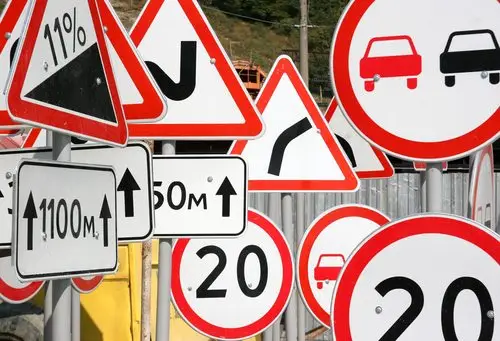

You passed your K53 learner’s licence test. You’ve been driving for years. You’re a confident, capable driver who knows the roads. But here’s the question: can you actually name every road sign you drive past? Not just Stop and Yield, but the ones that warn you about concealed driveways, loose stones, and uneven roads? Most of us can’t, and that’s a problem, because those signs exist to keep you alive.
South Africa’s road signs are governed by the National Road Traffic Act 93 of 1996, and there are hundreds of them. This quiz focuses on 10 of the ones drivers most commonly ignore or misidentify. It’s multiple choice, it’s fun, and it might just remind you of something important the next time you’re behind the wheel.
Key takeaways
- South Africa's road signs are set by the National Road Traffic Act 93 of 1996.
- Warning signs are typically yellow diamond-shaped boards that alert you to hazards ahead.
- Regulatory signs (like No Pedestrians) are round and carry legal weight, meaning you must obey them.
- Failing to obey road signs can result in fines, licence demerit points, or worse, a serious accident.
- Brushing up on lesser-known signs is one of the simplest ways to make every trip safer.
South Africa's road signs are regulated under the National Road Traffic Act 93 of 1996, which prescribes the shape, colour, and meaning of every sign on public roads.
Why knowing your road signs actually matters
Road signs aren’t decorative. Each one carries specific legal or safety weight, and ignoring them, even accidentally, can have serious consequences. Warning signs alert you to a hazard ahead so you can slow down and prepare. Regulatory signs tell you what you must or must not do. Information signs help you navigate. Miss one, and you could be heading into a concealed driveway, a stretch of gravel road, or a section with loose stones at the wrong speed.
The good news is that road sign knowledge is entirely learnable. A quick refresh is all it takes to turn an unfamiliar symbol into something you’ll recognise instantly at 120 km/h on the N1.
- Warning sign
- A road sign, typically yellow and diamond-shaped in South Africa, that alerts drivers to a potential hazard or change in road conditions ahead.
- Regulatory sign
- A road sign that prescribes or prohibits specific driver behaviour. These signs carry legal force under the National Road Traffic Act, and ignoring them is an offence.
How South African road signs are organised
Before you take the quiz, a quick cheat sheet on sign categories. Knowing the category helps you decode an unfamiliar sign on the spot.
| Category | Shape | Colour | What it means |
|---|---|---|---|
| Warning | Diamond | Yellow with black symbol | Hazard or change in road conditions ahead |
| Regulatory (prohibitory) | Circle | Red border, white background | Something you must NOT do |
| Regulatory (mandatory) | Circle | Blue background | Something you MUST do |
| Information / guidance | Rectangle or square | Blue, green, or brown | Directions, distances, or services ahead |
| Temporary | Diamond | Orange with black symbol | Temporary hazard, usually roadworks |
The quiz: 10 road signs, 3 choices each
For each sign below, pick the answer you think is correct. The answers are at the bottom of the page. No peeking.
Question 1: the concealed driveway sign
This yellow diamond sign shows an arrow emerging from a side gap. What does it mean?
- A. Concealed driveway ahead
- B. Road curves ahead
- C. Sneaky arrow attacks ahead
Question 2: the wild animals sign
This yellow diamond sign shows the silhouette of a large antelope. What does it mean?
- A. Springboks are so majestic
- B. Wild animals ahead
- C. Wild rugby fans ahead
Question 3: the construction vehicles sign
This yellow diamond sign shows a flat-bed truck. What does it mean?
- A. Flat trucks ahead
- B. Construction vehicles crossing ahead
- C. Destruction derbies permitted here
Question 4: the no pedestrians sign
This round regulatory sign shows a walking figure with a line through it. What does it mean?
- A. No butt-scratching allowed
- B. No moon-walking allowed
- C. No pedestrians allowed
Question 5: the gravel road sign
This yellow diamond sign shows a road surface changing texture. What does it mean?
- A. Roads? Where we’re going, we don’t need roads
- B. Gravel road begins ahead
- C. Top of road is covered in bees
Question 6: the traffic control sign
This yellow diamond sign shows a figure with arms outstretched. What does it mean?
- A. Traffic control ahead
- B. Throw your hands in the air like you just don’t care
- C. Taxi rank ahead
Question 7: the maximum width sign
This regulatory sign shows a number (for example, 2.1) with arrows pointing outward on both sides. What does it mean?
- A. You must be this tall to ride on this road
- B. Traffic will take approximately 2.1 minutes
- C. Maximum width limit
Question 8: the headlights sign
This regulatory sign shows a headlight symbol. What does it mean?
- A. Activate giant Cyclops robot and proceed to take over the world
- B. Turn coffee cup sideways
- C. Turn on headlights
Question 9: the uneven road sign
This yellow diamond sign shows a wavy road surface. What does it mean?
- A. Ocean ahead
- B. Uneven road ahead
- C. Mexican wave ahead
Question 10: the loose stones sign
This yellow diamond sign shows small circles flying off a road surface. What does it mean?
- A. Loose stones ahead
- B. Explanatory science diagrams ahead
- C. Killer tomatoes will look at your tyres
Answers
How did you do? Here are the correct answers:
- Question 1: A. Concealed driveway ahead
- Question 2: B. Wild animals ahead
- Question 3: B. Construction vehicles crossing ahead
- Question 4: C. No pedestrians allowed
- Question 5: B. Gravel road begins ahead
- Question 6: A. Traffic control ahead
- Question 7: C. Maximum width limit
- Question 8: C. Turn on headlights
- Question 9: B. Uneven road ahead
- Question 10: A. Loose stones ahead
Score yourself
- 9-10 correct: You’re royalty on the road. The kingdom salutes you.
- 6-8 correct: Solid effort. A quick flip through the K53 handbook and you’ll be perfect.
- 3-5 correct: Time for a refresher. The road signs are there to help you, not trick you.
- 0-2 correct: Please don’t drive on the N1 until you’ve revised. We say this with love.
What to do if you got some wrong
Don’t stress. Road sign knowledge fades over time, especially for signs you rarely encounter. Here’s how to get back up to speed quickly.
The K53 learner's manual is the official study guide for the South African learner's licence test and covers all road sign categories prescribed by the National Road Traffic Act.
Road signs and your car insurance: the connection you didn’t expect
Here’s something most drivers don’t think about: ignoring road signs can affect your car insurance claim. If an insurer investigates an accident and finds that you drove past a warning sign at full speed, or ignored a regulatory sign, it could be used as evidence of negligence. In some cases, that can reduce or even void a claim.
Comprehensive car insurance from King Price covers your vehicle against accidents, theft, fire, and more. But the best claim is the one you never have to make, and knowing your road signs is one of the simplest ways to avoid the accident in the first place.
Most road accidents aren't random. They're the predictable result of a driver being surprised by a hazard that a road sign warned them about 200 metres earlier.
Driving in a manner inconsistent with road signs or traffic conditions can constitute negligence, which may affect the outcome of an insurance claim investigation.
King Price road awareness content series
Drivers who actively engage with road safety content are more likely to self-report cautious driving behaviour, including reducing speed near warning signs and checking mirrors at regulatory signs.
Key takeaway
In summary: road signs exist to prevent accidents, and knowing them is one of the cheapest, easiest safety upgrades you can make as a driver. If this quiz revealed a gap or two in your knowledge, that’s a good thing. Now you know what to brush up on. Stay safe out there, and remember: the king wants his clients to arrive in one piece.
Last reviewed:
Frequently asked questions
Update history (1)
- Fully restructured and rewritten with updated quiz format, road sign category explainer, scoring guide, revision how-to, FAQ schema, and SEO/AEO/GEO/AIO optimisation for 2026.
Ready to protect your car as well as you now know your road signs? Get a King Price car insurance quote and see how little it costs to keep your kingdom rolling safely. The king’s got your back, on every road, past every sign.
