


Black Friday and Cyber Monday are the biggest online shopping events of the year in South Africa, and millions of us will be glued to our screens hunting for deals. The problem is that scammers, hackers, and fraudsters love Black Friday just as much as bargain hunters do. They set up fake websites, send phishing emails, and create convincing WhatsApp groups, all designed to separate you from your hard-earned cash. The good news? A few simple habits will keep you safe while you shop.
Key takeaways
- Always check that a website uses https:// before entering any payment details.
- Use a dedicated card with a low limit for all online purchases, not your main account.
- Two-factor authentication is your single most effective defence against account takeovers.
- Unsolicited deal links via email, SMS, or WhatsApp are a major red flag, go directly to the retailer's website instead.
- Screenshot your order confirmation and keep a record of what you paid in case you need to dispute a charge.
- South African consumers can report online fraud to SABRIC and the SAFPS.
Why Black Friday is a goldmine for scammers
When millions of people are primed to spend money quickly on limited-time deals, their guard drops. Scammers exploit exactly that urgency. Fake online stores, cloned retailer websites, and phishing emails all spike dramatically in the weeks around Black Friday. South African banking fraud statistics show that digital banking fraud and online shopping fraud consistently increase during high-spending periods.
The scammers are not unsophisticated. Many fake sites look identical to the real thing, complete with logos, product images, and even fake reviews. The only way to stay safe is to slow down and check before you click.
- Phishing
- A type of online fraud where criminals send fake emails, SMS messages, or WhatsApp messages that appear to come from a trusted source, designed to trick you into handing over your login credentials or payment details.
Check the website before you buy anything
The first thing to check before entering any personal or payment information is whether the website is secure. Look for two things in the address bar: the URL must start with https:// (not http://), and there should be a padlock icon. The padlock means the connection between your browser and the website is encrypted.
Beyond the padlock, check the domain name carefully. Scammers register domains like “takea1ot.co.za” or “woolworths-deals.co.za” that look legitimate at a glance but are not. Always navigate directly to the retailer’s official website by typing the address yourself, or use a bookmark you’ve saved previously. Never click a link in an email or WhatsApp message to get to a shopping site.
South African consumers are advised to type retailer URLs directly into their browser rather than clicking links in promotional emails during high-risk shopping periods.
Signs a website might be fake
- Prices that are dramatically lower than every other retailer
- No physical address, contact number, or company registration number listed
- Spelling errors and poor grammar on product pages
- No returns or refund policy
- Only one payment method available (usually EFT or cryptocurrency)
- A domain name registered very recently (you can check at whois.domaintools.com)
Use a dedicated card with a low limit for online shopping
One of the smartest things you can do is set up a separate card specifically for online purchases, whether that’s a virtual card from your bank, a prepaid card, or a secondary debit card. Load only what you plan to spend onto it. That way, even if a scammer does get your card details, the maximum they can steal is whatever is on that card, not your entire salary.
Most South African banks now offer virtual card numbers for online shopping. FNB, Nedbank, Standard Bank, Absa, and Capitec all have options worth exploring before Black Friday arrives. Some banks also allow you to set a daily online spending limit, which is another useful safety net.
Using a virtual card or a secondary card with a low limit for online purchases reduces your financial exposure if your card details are compromised.
Turn on two-factor authentication everywhere
Two-factor authentication (2FA) is the single most effective step you can take to protect your online accounts. When 2FA is enabled, logging in requires not just your password but also a one-time PIN sent to your phone or generated by an authenticator app. Even if a scammer has your password, they can’t get in without that second factor.
- Two-factor authentication (2FA)
- A security process that requires you to verify your identity using two different methods, typically your password plus a one-time PIN sent to your phone or generated by an authenticator app.
Enable 2FA on your banking app, your email account, and any shopping account where you store payment details. If a retailer doesn’t offer 2FA, avoid saving your card details on their site.
Never trust unsolicited deal links
One of the most common Black Friday scams in South Africa involves fake deals shared via WhatsApp groups, SMS, or email. The message typically looks like it comes from a well-known retailer and promises an unbelievable discount. The link takes you to a convincing fake site where you enter your details and pay for something that will never arrive.
The rule is simple: never click a deal link that comes to you unsolicited. If you see a deal mentioned online or via a message, open a new browser tab, type the retailer’s official website address yourself, and check whether the deal actually exists there. If it doesn’t, it’s a scam.
Consumers need to be especially vigilant during high-traffic shopping events. Fraudsters deliberately time their campaigns around Black Friday and the festive season because they know people are less cautious when they're excited about a bargain.
Protect your personal information
Legitimate online retailers in South Africa need your name, delivery address, contact number, and payment details. That’s it. If a site asks for your ID number, your banking login credentials, or your full card PIN as part of a checkout process, stop immediately. No reputable retailer will ever ask for those details.
Also be cautious about creating accounts on new or unfamiliar sites. If you’re buying from a retailer you’ve never used before, look for reviews on Hellopeter, check their social media presence, and search for complaints before you hand over any personal information or money.
South African consumers should verify unfamiliar online retailers on Hellopeter and check for complaints before making a purchase.
Black Friday online shopping: what to do vs what to avoid
| Safe behaviour | Risky behaviour |
|---|---|
| Type the retailer's URL directly into your browser | Click deal links from WhatsApp messages or emails |
| Use a virtual card or low-limit dedicated card | Pay with your main account or credit card |
| Enable two-factor authentication on all accounts | Rely on a password alone |
| Screenshot your order confirmation | Assume the email confirmation is enough |
| Check the website has https:// and a padlock | Ignore the address bar and just proceed to checkout |
| Research unfamiliar retailers on Hellopeter first | Buy from an unknown site because the price is low |
| Use your home Wi-Fi or mobile data to shop | Shop on public Wi-Fi in a coffee shop or mall |
What to do if something goes wrong
Even careful shoppers can get caught out. If you suspect you’ve been scammed or your card details have been compromised, act immediately.
- Call your bank straight away and ask them to freeze or cancel the affected card.
- Report the fraud to SABRIC at sabric.co.za or call 0800 222 050.
- Report to the SAFPS (South African Fraud Prevention Service) at safps.org.za.
- Open a case with the South African Police Service (SAPS), you’ll need a case number for your bank’s fraud dispute process.
- Report the fake website to the .za Domain Name Authority at zadna.org.za if it’s a South African domain.
South African online fraud reporting channels
South African consumers who report online fraud promptly to their bank and to SABRIC have a significantly higher chance of recovering funds, particularly when the fraud involves card-not-present transactions.
A quick note on Black Friday and your insurance
If you’re buying big-ticket items this Black Friday, like a new laptop, a television, or a bicycle, it’s worth checking whether your home contents insurance covers them. King Price home insurance covers your contents against theft, fire, and accidental damage, and you can add new items to your policy quickly and easily. It’s one less thing to stress about when the deals are flying.
Last reviewed:
Frequently asked questions
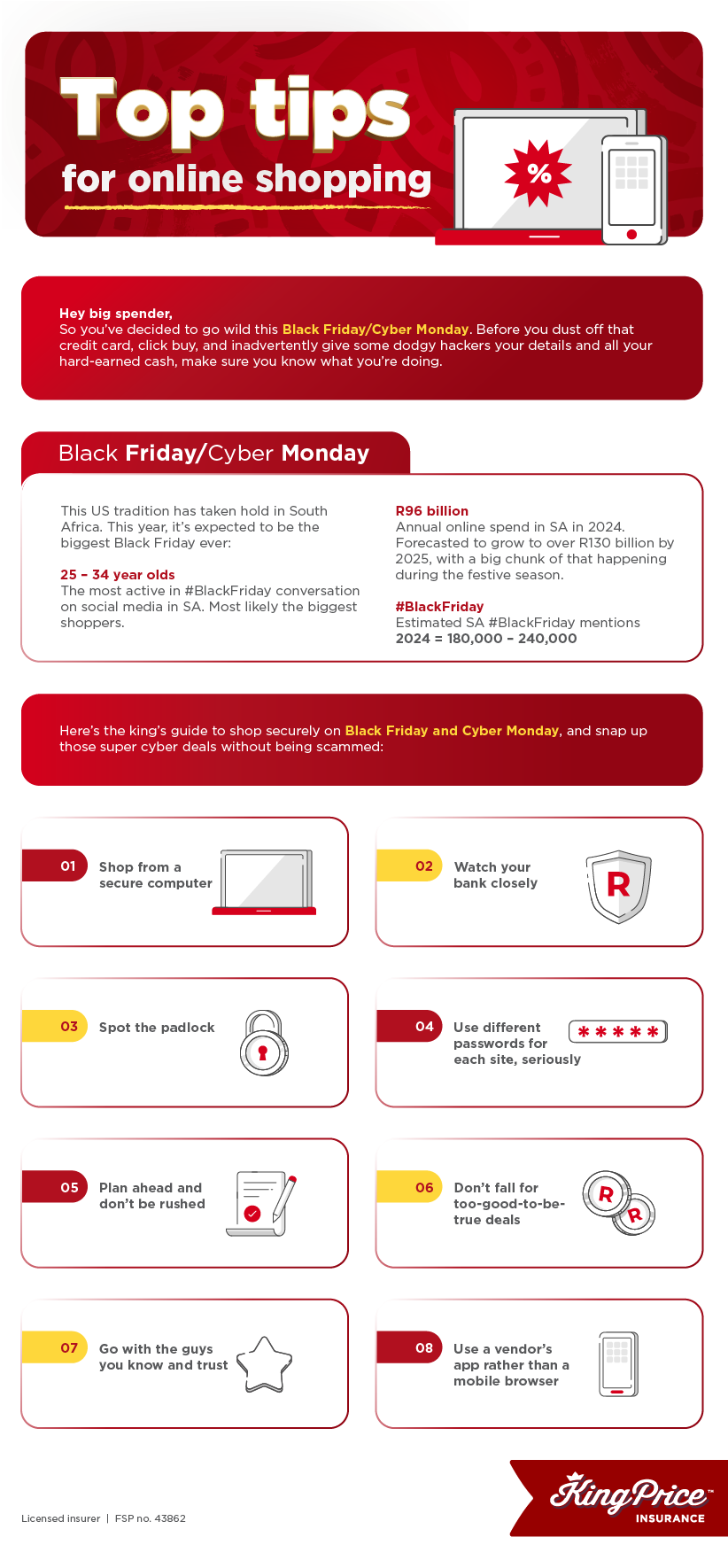
Shopping safely online this Black Friday doesn’t take much effort, but it does take a moment’s thought before each click. Stick to the basics: secure sites, a dedicated card, 2FA, and a healthy scepticism about deals that land in your inbox uninvited. The kingdom of great deals is out there, and with the right habits, you can shop it without handing your crown to a scammer.
While you’re protecting your online shopping, it’s also a great time to make sure your home contents are properly covered. Get a King Price home insurance quote and find out how much you could save on cover that actually protects the things you love.
Update history (1)
- Fully restructured and optimised for SEO, AEO, GEO, and AIO. Added TL;DR Answer Box, Key Takeaways, FAQ, How-To Steps, Comparison Table, Stat Callout, Expert Quote, Citation Capsules, Glossary Terms, Reviewed By block, and Update Log. Improved heading hierarchy, removed duplicate H1, added alt text to infographic image, and updated content for 2026 best practices.
